
Parapet Repair NYC
Since January 1, 2024, New York City requires an annual parapet observation for every building with a parapet facing public space. MC Construction is a licensed contractor with 20+ years restoring these rooftop walls – safely, at height, and in full DOB compliance.
We take the entire parapet problem off a building owner’s hands: condition assessment alongside engineers, fall-protection and overhead safeguards, structural masonry rebuilds, coping replacement, waterproofing, and DOB violation removal. Our work covers commercial, residential, and landmarked buildings across Manhattan, Brooklyn, and Queens.
- ✓ 20+ YEARS IN NYC
- ✓ 1 RCNY §103-15
- ✓ DOB PARAPET COMPLIANCE
- ✓ IN-HOUSE MASONRY & ROOFING CREWS
What does our compliance-backed parapet repair NYC include?
Our compliance-backed parapet repair NYC includes structural masonry restoration, coping stone replacement, comprehensive waterproofing systems, and professional inspection support — delivered end to end by a single licensed contractor.
A parapet failure is rarely just one defect. The masonry, the coping, the flashing, and the connection to the roof deteriorate together, and a compliant repair has to address all of them at once. As an established general contractor NYC, MC Construction self-performs the masonry and roofing scopes in-house and coordinates the inspection so the building owner deals with one accountable team. Here is how we break down a full parapet program.
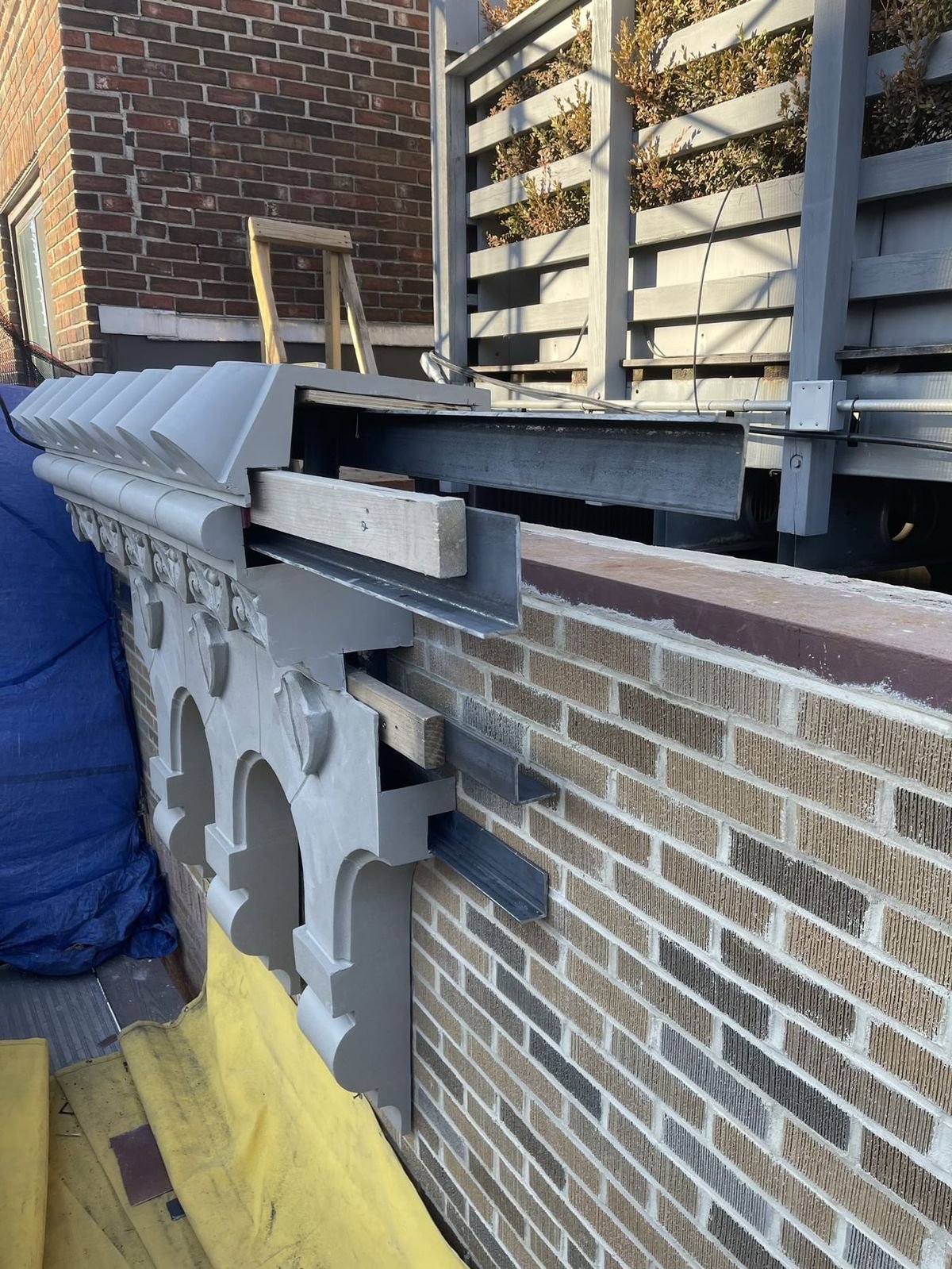

Every project starts by documenting exactly what is failing and why, in a format your engineer can act on:
- Close-range visual observation of the full parapet run
- Locating masonry cracks, bulging, and out-of-plumb sections
- Detecting deteriorated concrete copings and metal flashings
- Photo documentation prepared for the inspecting engineer

This is the core repair – rebuilding the wall so it is sound, plumb, and anchored:
- Brick parapet rebuilds and selective re-facing
- Repointing and selective mortar joint restoration by a licensed masonry contractor
- Resetting or replacing damaged coping stones
- Installation of structural anchors, tie-backs, and stabilization steel coordinated with structural steel fabrication
- Concrete coping and curb reconstruction tied to structural concrete foundations

Water entering from the roof side is what destroys a parapet – so we seal every joint and transition:
- Sheet-metal flashing and counter-flashing installation and repair via metal roof systems NYC
- Sealing of joints, expansion joints, and coping seams
- Protection of the wall against water intrusion from the roof line, tied to waterproof roof replacement NYC
- Coping bedding and through-wall waterproofing details

Parapet work happens at the roof edge above the public, so access and protection come first:
- Roof-access planning and staging
- Suspended scaffolding and rigging setup
- Protective overhead safeguards, including sidewalk sheds for pedestrians below
- Full OSHA and DOB compliance throughout the work
Why is an annual parapet observation NYC legally required for your building?
Under 1 RCNY §103-15, every building in New York City with a parapet facing public space must undergo an annual safety observation – regardless of the building’s height – making the annual parapet observation NYC a recurring legal obligation, not a one-time inspection.
This requirement, in force since January 1, 2024, closed a long-standing gap in NYC’s facade safety rules. The older FISP program (Local Law 11) only covers buildings over six stories, which left thousands of smaller buildings with unmonitored rooftop walls hanging over the public. The parapet rule, grounded in NYC Administrative Code §28-301.1.1, now reaches buildings of every height.
The buildings that must comply include:
- Townhouses and brownstones with street-facing parapets
- Low-rise and mid-rise residential buildings
- Commercial and retail buildings
- Any structure whose parapet faces a public right-of-way
Failing to observe and maintain a parapet exposes the owner to DOB penalties and, where a wall is found hazardous, an order to immediately install protection such as sidewalk sheds. Staying ahead of the requirement with a qualified contractor is far cheaper than reacting to a violation.
When should you hire a licensed parapet inspection contractor NYC to address structural cracks?
You should call a licensed parapet inspection contractor NYC the moment you notice loose bricks, falling mortar, or a parapet crown leaning out of plumb – well before the deficiency progresses to an “Unsafe” classification and a forced shutdown of the area below.
Parapets fail from the top down, and the New York climate accelerates it. Every winter, water seeps into the masonry joints and coping seams, then freezes and expands – a freeze-thaw cycle that NYC walls endure dozens of times each season. Each cycle widens cracks, pushes copings out of position, and loosens the brick until a section is one storm away from coming down onto the street.
Catching it early is the entire game. Once a parapet is visibly leaning, shedding mortar, or showing displaced coping, it is no longer a maintenance item – it is a safety hazard that an inspector can flag as Unsafe. The same urgency applies to parapet repair Queens brownstones and the pre-war walls of Brooklyn and Manhattan, where decades of accumulated freeze-thaw damage are common. On landmarked masonry we draw on our brownstone restoration crews for matching stone copings, and renew any failed wall finish with stucco repair where the parapet was originally parged. Acting at the first warning sign lets us perform a planned masonry repair instead of an emergency stabilization.
How do our crews resolve DOB violations and unsafe roof conditions?
We resolve violations in two stages: MC Construction rapidly mobilizes to install temporary safeguards that clear the immediate hazard, then executes permanent repairs to the inspecting engineer’s specification so the condition is corrected and the DOB violation is removed.
When an inspector flags a parapet, the clock starts – and the response has to protect the public first and satisfy the DOB second. Our workflow is built for exactly that sequence:
- Immediate safety measures: for loose masonry or a displaced coping, we secure or remove the hazard and install protective netting and sidewalk sheds where the wall faces the public.
- Engineer-coordinated permanent repair: we rebuild the parapet – re-laying brick, resetting or replacing copings, installing anchors, and renewing flashing – to the structural detail the engineer requires.
- Documented close-out: we record every repair in the format needed to clear the violation and confirm DOB parapet compliance, removing the penalty exposure.
Because we self-perform the masonry, coping, and flashing work, there is no waiting on subcontractors between the temporary fix and the permanent one – the same crew that secures the wall is the crew that rebuilds it.
Why choose MC Construction for your NYC parapet wall restoration?
Choose MC Construction because we deliver a 2-in-1 service for your NYC parapet wall restoration – we prepare the building for inspection and then execute the corrective masonry and roofing repairs with our own crews, with no subcontractor delays.
Most owners get bounced between an inspector who only reports the problem and a contractor who only shows up weeks later. We close that gap by handling both the compliance support and the construction.

Two decades of masonry and facade restoration across Manhattan, Brooklyn, and Queens – pre-war brownstones, landmarked parapets, and modern brick. We know how these walls fail and how to rebuild them to last.

Our own masons and roofers perform the rebuild, coping, and flashing work directly – no subcontractor markup, no scheduling gaps between the temporary safeguard and the permanent fix.

We prepare the building for the annual parapet observation, coordinate with your engineer, and carry the findings straight into a corrective scope – one team from observation to sign-off.

OSHA-certified at-height work, sidewalk sheds and overhead protection where required, and full DOB documentation to clear violations and keep your building compliant.
Serving parapets across Manhattan, Brooklyn & Queens
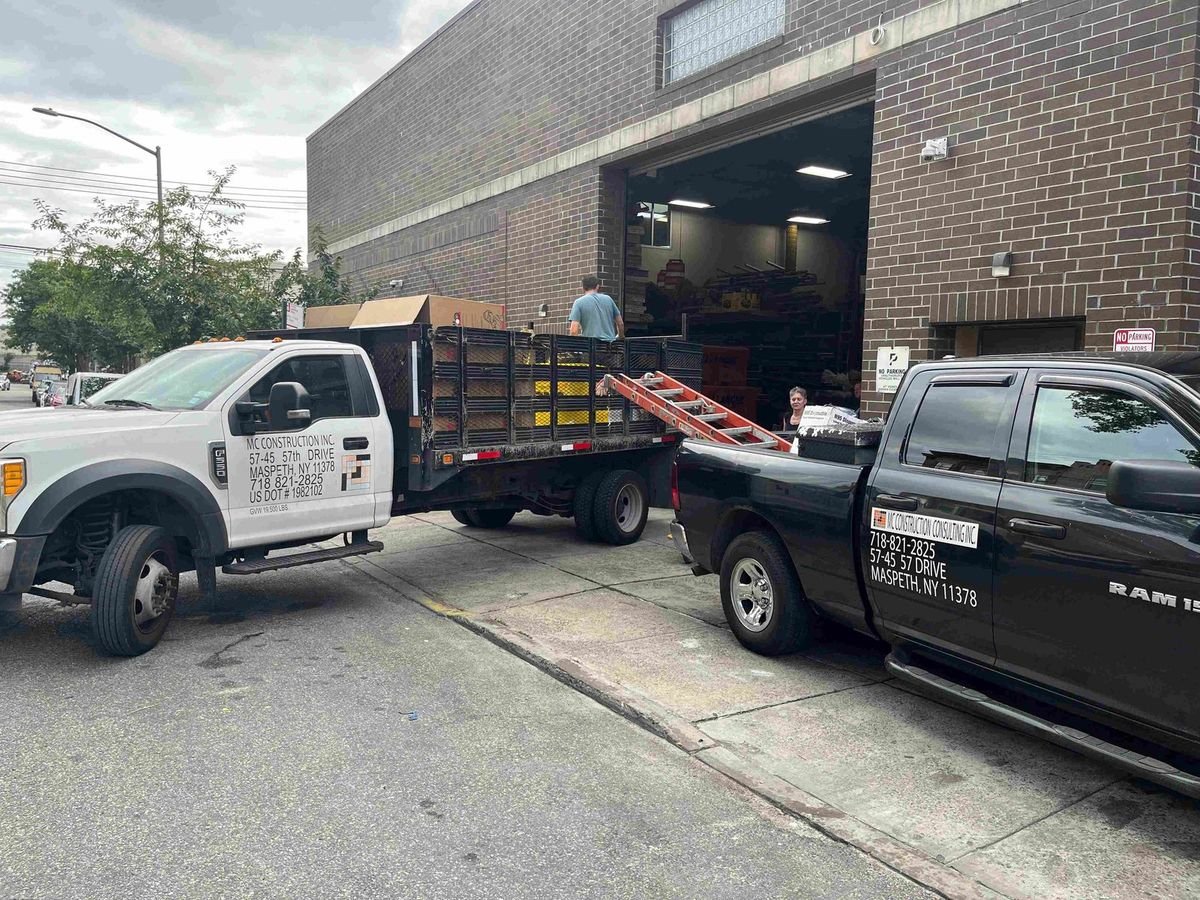
MC Construction restores and maintains parapet walls throughout New York City – from the brownstone rows of Brooklyn and the townhouses of Manhattan to commercial and residential buildings across Queens. Our crews and equipment are based in Maspeth, Queens, and mobilized citywide.
Frequently Asked Questions
What is the deadline for filing the annual parapet observation NYC report?
The annual parapet observation must be completed once every calendar year, with the observation performed by a qualified professional and the resulting report kept on file by the building owner. Unlike FISP, the report is not filed with the DOB on a fixed citywide date – instead, the owner must have a current annual observation on record and produce it on request, while correcting any conditions the observation identifies.
Because the obligation recurs every year, the practical deadline is simply staying current: never letting more than twelve months pass without a completed observation. MC Construction helps owners stay ahead of that cycle and addresses any deficiencies the observation surfaces before they escalate.
What is a coping stone and why does it need to be sealed?
A coping stone (or coping) is the cap that sits on top of a parapet wall, covering the exposed masonry below. It is the parapet’s first line of defense against the weather: it sheds rain away from the wall and keeps water out of the brick and mortar underneath.
Coping joints must be sealed because the seams between coping units – and the bed where the coping meets the masonry – are the most common entry point for water. Once those joints open up, water runs straight into the core of the parapet, freezes, and breaks the wall apart from the inside. Resetting copings on a fresh bed and sealing the joints is one of the highest-value steps in any parapet repair.
Does my building need a sidewalk shed during parapet repair NYC?
It depends on the condition of the wall and the work involved. If a parapet is classified unsafe, or if the repair work takes place directly above a public right-of-way, the DOB will typically require a sidewalk shed (sidewalk bridge) to protect pedestrians below before and during the work.
For a planned, lower-risk repair on a wall that is still stable, overhead protection may be limited to the work zone rather than a full shed. We assess each building individually, install exactly the protection the DOB and OSHA require for that scope, and remove it as soon as the parapet is made safe – so you are never paying for more shedding, or for longer, than the job actually needs.

Need your parapet observed, repaired, or cleared of a violation?
Send us your observation report or describe what you’re seeing at the roof line. We’ll assess the wall, scope the repair, and handle the compliance from start to finish.