
A brownstone in Park Slope, a brick row house in Bed-Stuy, a 100-year-old townhouse in Brooklyn Heights – beautiful buildings, and every one of them fighting the same enemy: water. Here’s an engineer’s look at the common waterproofing problems in older homes, the warning signs to watch for, and how a top rated waterproofing contractor in Brooklyn actually solves them.
If you own an older home in Brooklyn, you already know the feeling: the faint musty smell at the bottom of the stairs, the chalky white bloom on the cellar wall, the ceiling stain that comes back every spring no matter how many times you paint over it. These are not cosmetic annoyances – they are the visible symptoms of brooklyn townhouse waterproofing problems that have been developing, quietly, for decades.
Brooklyn’s housing stock is largely pre-war: solid masonry construction in brick, brownstone, and sandstone, much of it built before modern damp-proofing existed. That construction is wonderfully durable, but it was never sealed the way a new building is. Over a century of freeze-thaw cycles, settling, and rising water tables, the mortar breathes, the foundation cracks hairline by hairline, and water finds every path you’d never think to look for. Recognising the early signs of water damage in brownstones – and understanding what’s really causing them – is the difference between a planned repair and an emergency.
The most common waterproofing problems in older homes
Almost every case of basement water leakage in a Brooklyn townhouse comes back to one of a handful of mechanisms. Water is patient and relentless, and in a 19th-century building it usually exploits the same weak points:
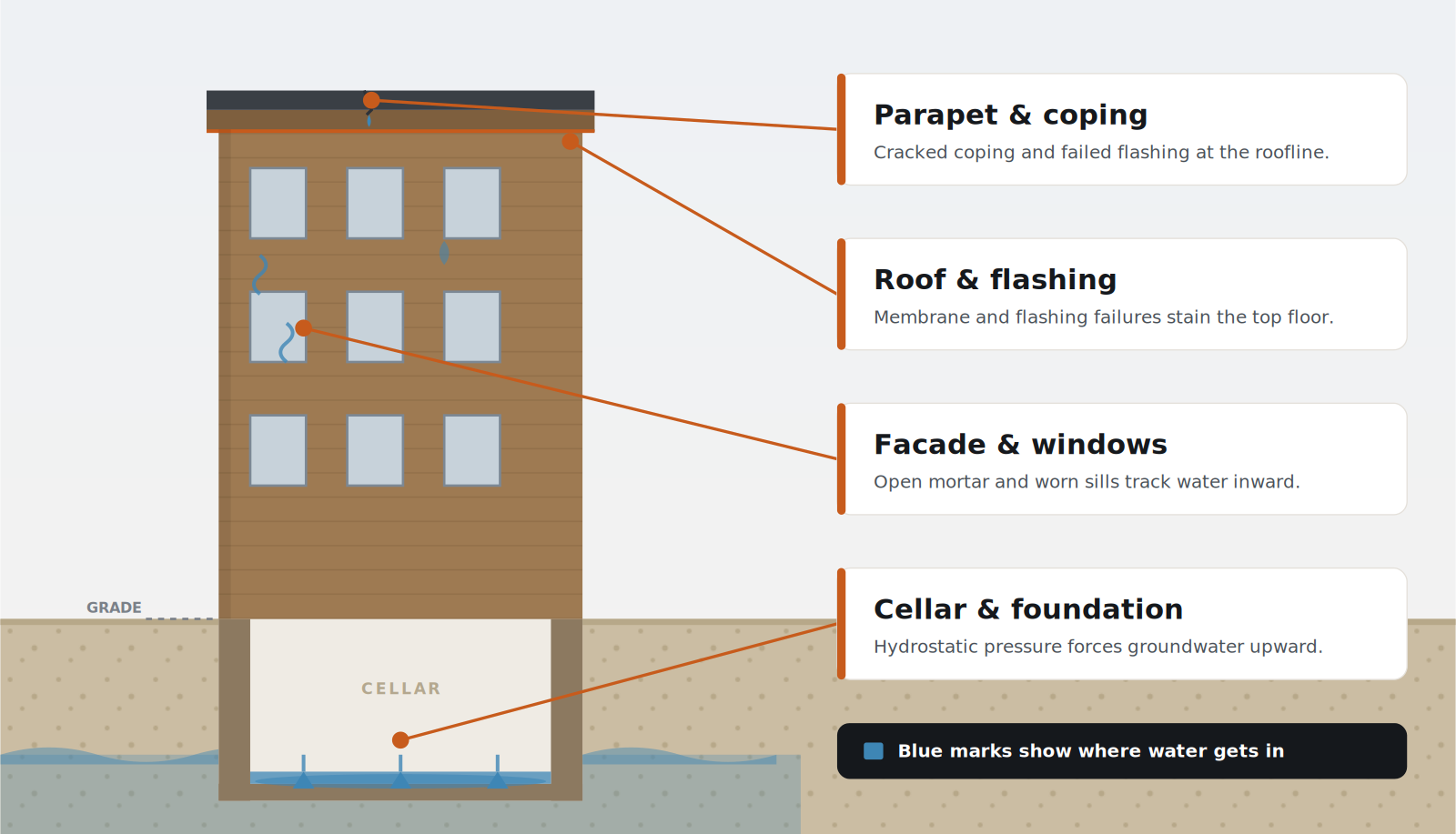
- Hydrostatic pressure. After heavy rain, the water table under your cellar rises and pushes up and inward through the slab and foundation walls. This is the single biggest driver of recurring cellar flooding, and it can’t be solved by paint – it has to be relieved and drained. It’s the core of what we do on our waterproofing projects.
- Masonry porosity and failed mortar. Old brick and brownstone are absorbent by nature. Once the pointing degrades, the wall behaves like a sponge, and you get brick facade water intrusion and damp interior walls well above grade.
- Failed flashing and sealants. At windows, parapets, and roof edges, the thin metal and sealant that once kept water out are often original – brittle, cracked, and long past their service life.
- Poor or blocked drainage. Areaways, rear yards, and downspouts that no longer move water away from the building send it straight back down against the foundation.
Understanding which mechanism is at work is the whole game. The best way to fix recurring waterproofing problems is never to chase the stain – it’s to trace the water back to its entry point and stop it there. That’s also why a quick patch from a handyman rarely lasts: it treats the symptom, not the path.
Waterproofing problems and solutions, at a glance
A quick reference to the most common waterproofing issues in Brooklyn townhouses – what causes them, what you actually see day to day, and how we solve them for good.
WHAT YOU SEE IN BROOKLYN
- Puddles after rain, a persistent damp basement odor, efflorescence (white salt) on cellar walls.
MC CONSTRUCTION’S PROFESSIONAL SOLUTION
- Exterior waterproofing membranes, French drain and sump systems that relieve hydrostatic pressure.
WHAT YOU SEE IN BROOKLYN
- Hairline to structural cracks, water weeping in at the floor-to-wall joint.
MC CONSTRUCTION’S PROFESSIONAL SOLUTION
- Crack injection, exterior waterproof membrane, and footing-level drainage to keep the foundation dry.
WHAT YOU SEE IN BROOKLYN
- Spalling brick, damp interior walls above grade, salt staining on the facade.
MC CONSTRUCTION’S PROFESSIONAL SOLUTION
- Repointing, breathable water-repellent treatment and full facade restoration through our building elevations work.
WHAT YOU SEE IN BROOKLYN
- Stains under sills, peeling paint at the reveal, rot at the frame or lintel.
MC CONSTRUCTION’S PROFESSIONAL SOLUTION
- Re-flashing, re-sealing, and lintel/sill repair as part of exterior wall restoration.
WHAT YOU SEE IN BROOKLYN
- Ceiling stains on the top floor, bubbling paint, drips during storms.
MC CONSTRUCTION’S PROFESSIONAL SOLUTION
- Membrane repair or replacement and new flashing to stop roof leaks at the source.
WHAT YOU SEE IN BROOKLYN
- Cracked coping, loose masonry at the roofline, damp on the upper interior walls.
MC CONSTRUCTION’S PROFESSIONAL SOLUTION
- Parapet rebuild, new coping and flashing, and waterproof coatings for parapet wall waterproofing.
WHAT YOU SEE IN BROOKLYN
- Pooling in the areaway or rear yard, downspouts that overflow at grade.
MC CONSTRUCTION’S PROFESSIONAL SOLUTION
- Regrading, area drains, and downspout tie-ins that move water away from the building.
WHAT YOU SEE IN BROOKLYN
- Musty smell, black spotting on walls or under finishes, allergy flare-ups indoors.
MC CONSTRUCTION’S PROFESSIONAL SOLUTION
- Eliminate the water source first, then remediate – mold that returns after cleaning means the leak is still active.
Problems by structural element: cellars, facades, roofs & parapets
The same townhouse presents different waterproofing problems at different elevations. Here’s how we diagnose each part of the building.
Cellars & basements
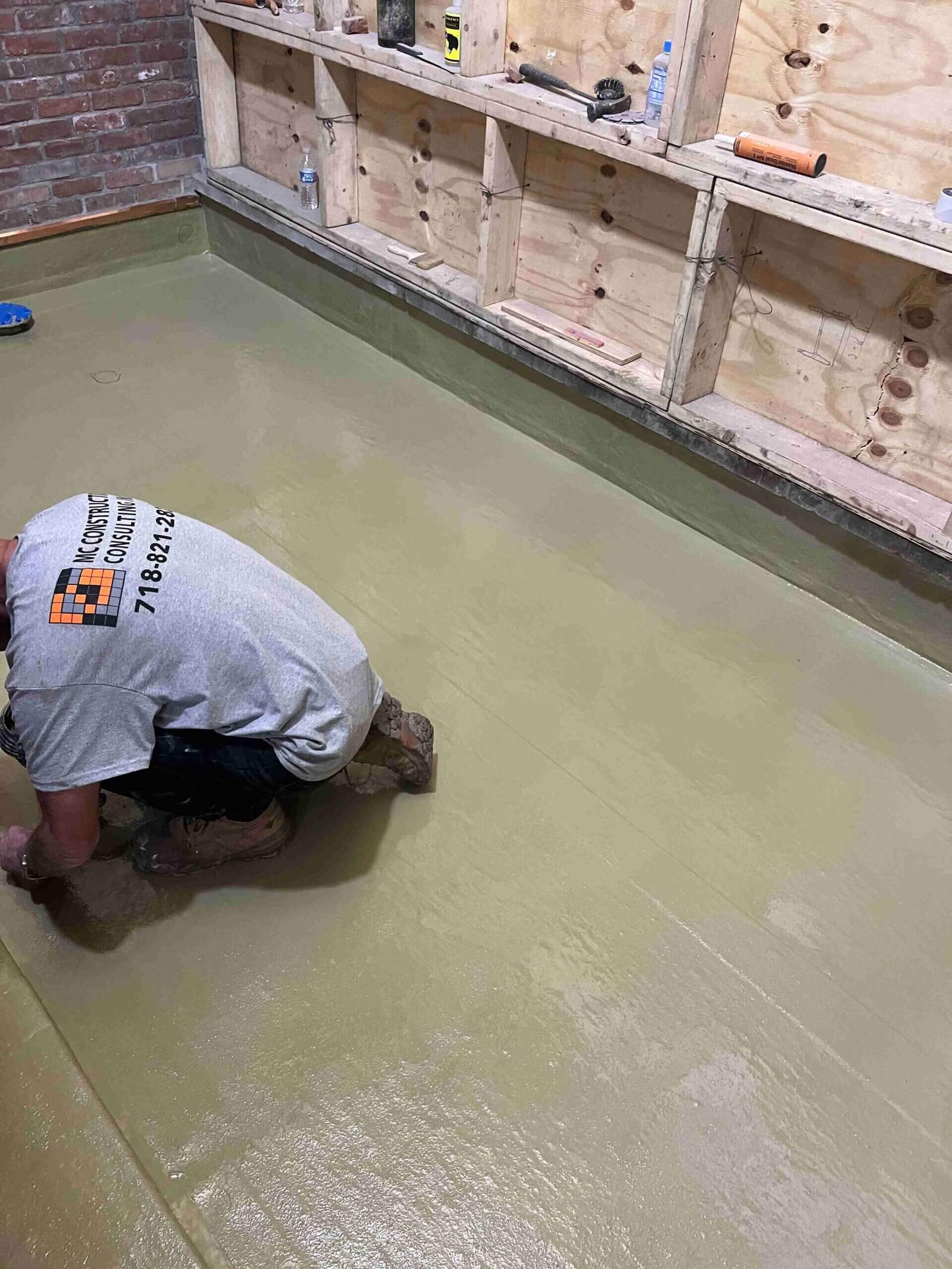
The cellar is where most Brooklyn homeowners first notice trouble. Cellar moisture problems in Brooklyn almost always trace back to hydrostatic pressure and poor drainage rather than a single “hole” – which is why spot-patching fails and the water comes back. A proper fix relieves the pressure and gives the water somewhere to go: perimeter drainage, a sump system, and a continuous membrane. If you’re dealing with a damp basement odor or standing water, start with our basement waterproofing services.
Facades & exterior walls
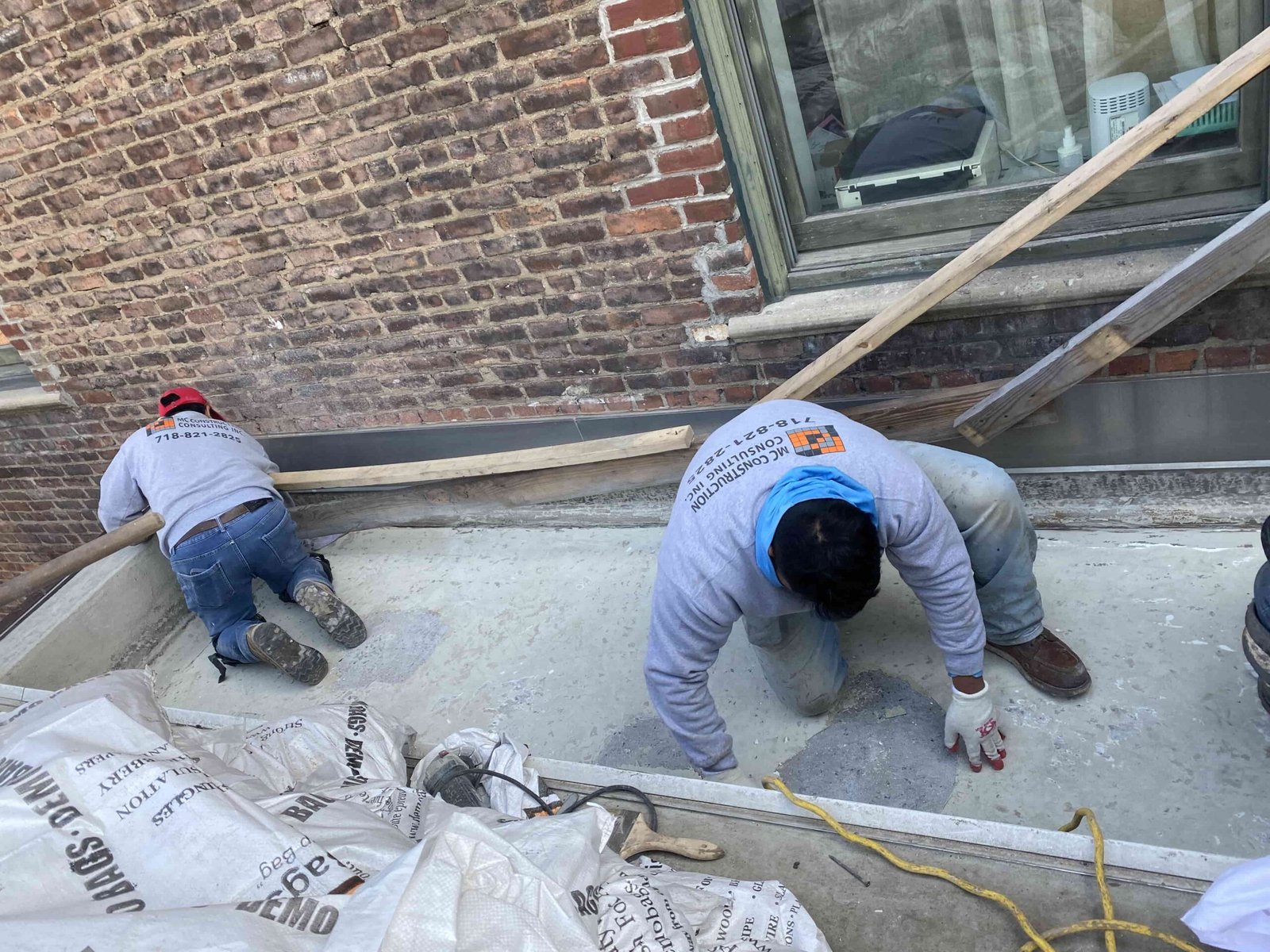
On a brownstone or brick row house, the facade is both the building’s face and its weather barrier. When the mortar joints open up, you get masonry water damage and moisture tracking to the inside of the wall. Brownstone waterproofing in Brooklyn is a specialty of its own – the stone is soft, historic, and often landmarked, so the repair has to protect the original material, not seal it in a way that traps moisture. This is exterior work, so it lives with our building elevations & facade restoration team, who handle repointing, water-repellent treatment, and window leak issues together as one scope.
Roofs
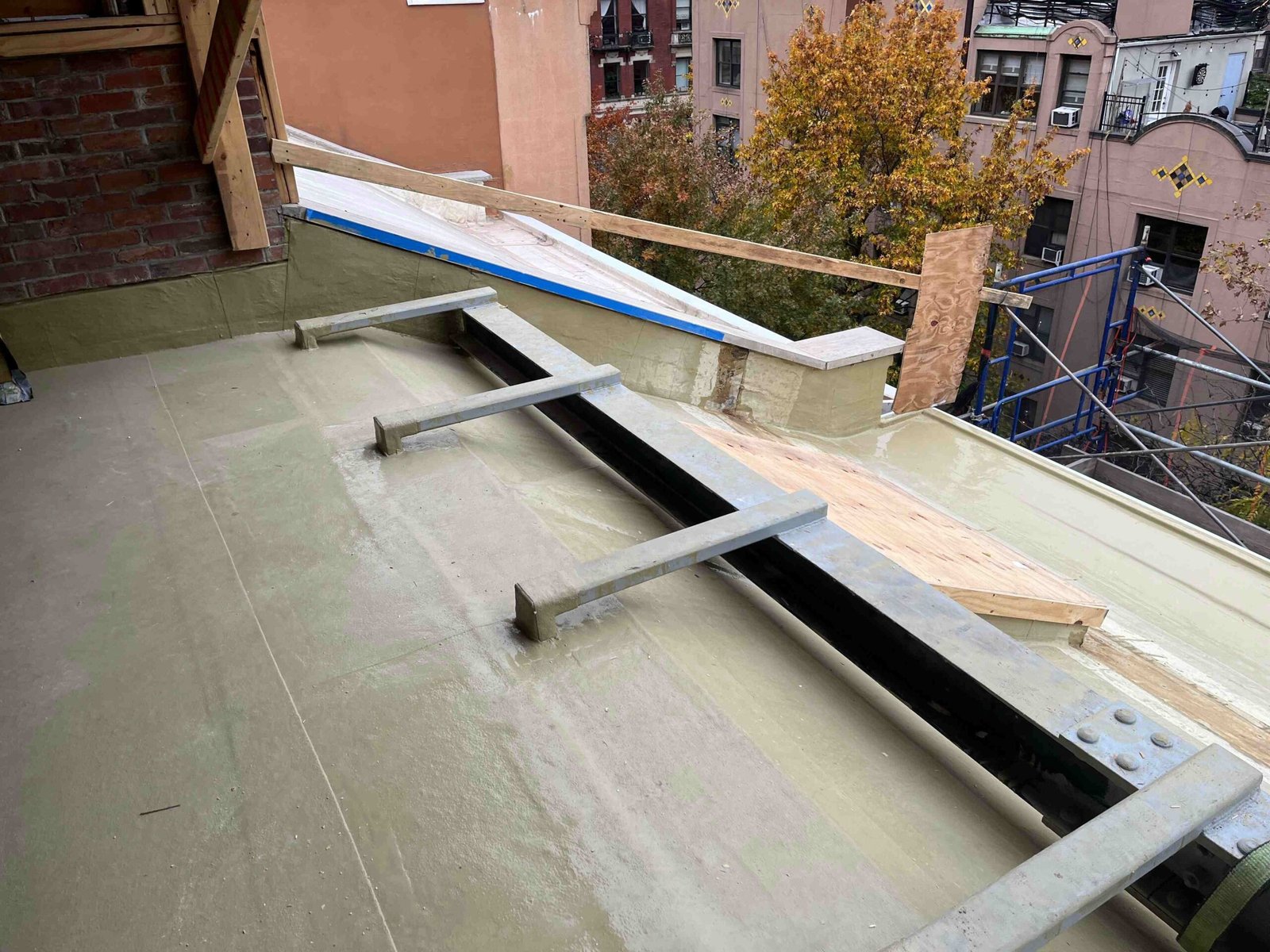
A roof leak in a Brooklyn townhouse rarely announces itself over the leak – water travels along framing and shows up rooms away. Flat and low-slope roofs common on row houses depend entirely on an intact membrane and sound flashing at every penetration and edge. When either fails, the top-floor ceiling is the first casualty.
Parapet walls
Parapets take the worst of the weather and are the most neglected part of most buildings. Cracked coping and failed flashing let water into the top of the wall, where it migrates down through the masonry – a classic source of upper-floor damp that gets misdiagnosed as a roof leak. Parapet wall waterproofing in Brooklyn means rebuilding the coping, renewing the flashing, and coating the assembly so the roofline sheds water instead of soaking it up.
Staying ahead: prevention & maintenance
The cheapest waterproofing is the leak that never starts. Knowing how to prevent water intrusion in townhouses comes down to a short, repeatable checklist: keep gutters, downspouts, and area drains clear so water moves away from the building; re-point open mortar joints before they start letting water in; check flashing and parapet coping every season; and keep the rear yard and areaway graded away from the foundation. Building this into a simple Brooklyn townhouse maintenance waterproofing routine, and catching small failures early, is one of the best waterproofing solutions for townhouses there is – it keeps a $500 repair from turning into a $15,000 one.
Not sure which of these is behind your leak? That’s exactly what an inspection is for – and as a full-service NYC general contractor, we can address the cellar, the facade, and the roof under one accountable team.
Frequently Asked Questions
Water damage never fixes itself, and in a historic Brooklyn townhouse it only gets more expensive the longer it’s left. If you’re seeing any of the signs below, the smartest first step is a proper inspection. Contact MC Construction and we’ll help you protect the building and its value for the long term.
What are the most common waterproofing problems in older Brooklyn homes?
The most common waterproofing problems in older homes are basement and cellar water leakage from hydrostatic pressure, foundation cracks, brick and brownstone facade water intrusion, leaking windows, roof leaks, and parapet wall failure. In Brooklyn townhouses these usually show up as a damp basement odor, efflorescence on cellar walls, and ceiling or wall stains that return after every heavy rain.
What’s the best way to fix recurring waterproofing problems?
The best way to fix recurring waterproofing problems is to trace the water back to its entry point and stop it there, rather than repainting or patching the stain. That means relieving hydrostatic pressure with proper drainage for cellars, repointing and treating masonry for facades, and renewing flashing at windows, roofs, and parapets. A patch treats the symptom; a real fix treats the path the water takes.
Why does my Brooklyn townhouse basement flood every time it rains?
Repeated basement flooding after rain is almost always caused by hydrostatic pressure: the water table rises and pushes water up through the slab and in through the foundation walls. Interior paint and sealers can’t hold that pressure back. The lasting solution is a drainage system – perimeter drains and a sump – combined with a waterproof membrane that relieves the pressure and channels the water away.
How do I choose a waterproofing contractor in Brooklyn?
Look for a licensed, insured contractor with real experience on older Brooklyn and NYC masonry buildings, not just modern construction. Among waterproofing companies in NYC, the ones worth hiring will inspect in person, explain the mechanism causing your leak, and give you an itemized scope – not a flat quote sight unseen. MC Construction is a licensed general contractor that handles the cellar, facade, and roof as one coordinated project.
Get a free waterproofing inspection
Recurring leak? Damp cellar? Stains that keep coming back? We’ll come out, find where the water is actually getting in, and give you an itemized plan to stop it from one of the top rated waterproofing contractors in NYC.