
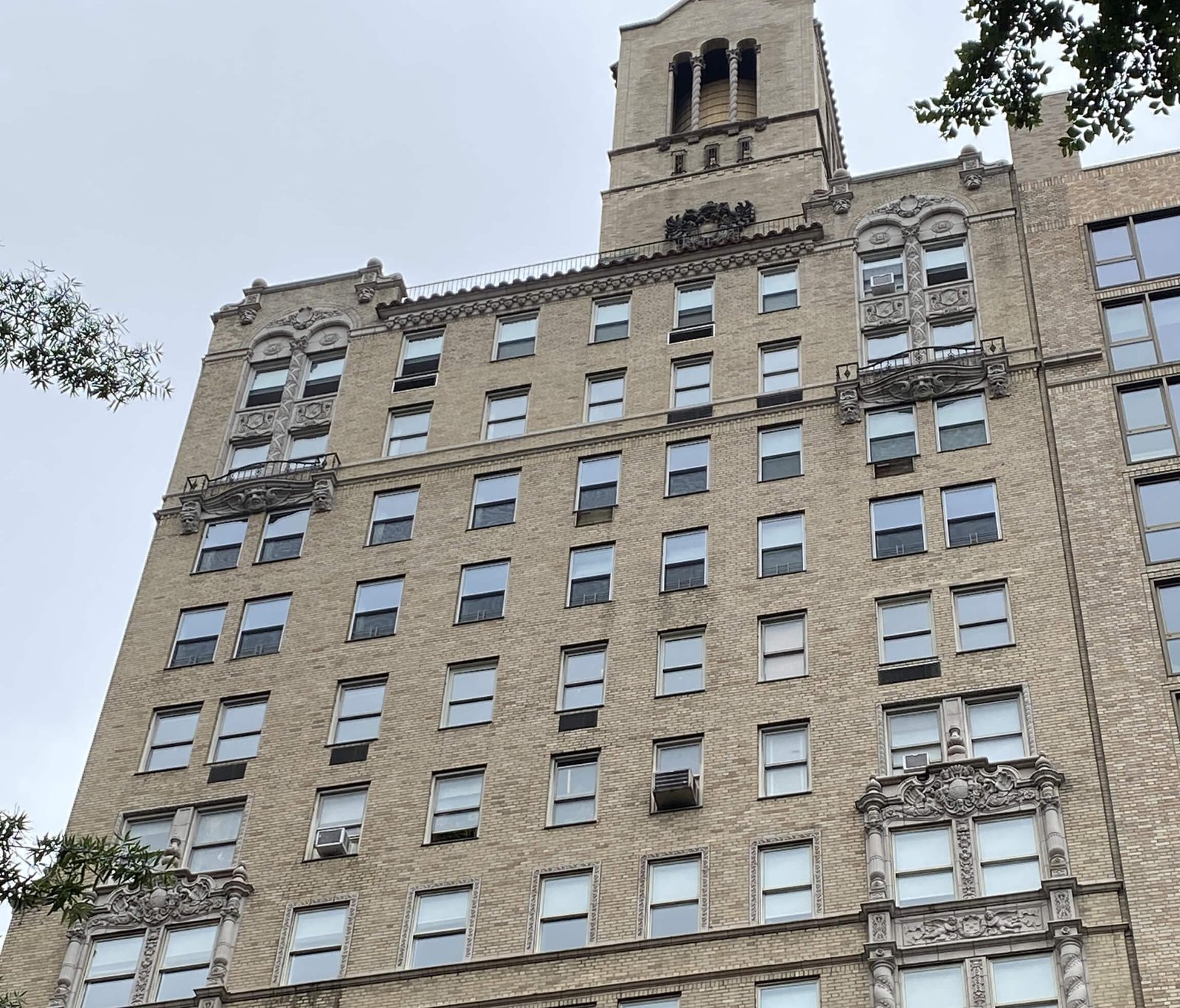
Masonry Contractor in Manhattan
Premium brick pointing and structural masonry restoration for historic townhouses and luxury properties across Manhattan Island.
From the landmarked brownstones of the West Village to the pre-war co-ops of the Upper East Side, Manhattan’s historic fabric demands a level of precision that most contractors cannot deliver. MC Construction Consulting has spent over two decades restoring brick facades, raking mortar joints, and rebuilding structural masonry across the borough’s most demanding addresses.
We understand that in Manhattan, every project is visible to neighbors, inspectors, and pedestrians. Our dustless systems, DOB-approved scaffolding, and forensic-level mortar matching ensure that your building looks exactly as it should-restored, not altered.
- ✓ NYC DOB Licensed
- ✓ LPC Compliant
- ✓ Fully Insured
- ✓ 20+ Years in NYC
Brick Pointing Manhattan
Constant ground vibrations from the subway system and severe seasonal freeze-thaw cycles are the primary causes of mortar joint failure in Manhattan’s historic buildings. As subway trains pass beneath streets dozens of times per day, micro-vibrations travel upward through a building’s foundation and load-bearing walls. Over years and decades, these vibrations loosen mortar at its bond line, creating hairline gaps that widen with each winter expansion cycle.
Manhattan’s dense urban canyon effect amplifies the problem. Buildings in Tribeca, Greenwich Village, Chelsea, and the Upper East Side are tightly packed, which concentrates heavy truck and bus vibration against already-stressed party walls. Water that infiltrates open mortar joints does not simply drain away-it is absorbed into the brick, freezes during winter, and expands with enough force to fracture the face of the brick itself.
In Manhattan’s numerous historic districts, the LPC mandates that mortar repairs replicate the original composition and color, that no Portland-heavy modern mixes are used on pre-1930 lime-based masonry, and that any scaffolding affecting the street requires a DOB-approved sidewalk shed. Failing to meet these requirements exposes property owners to fines, stop-work orders, and costly remedial work.
Properly addressing Manhattan masonry deterioration requires a contractor with documented LPC compliance experience, in-house mortar analysis capability, and crews trained on historic building materials-not a general contractor who handles brickwork as a side service.
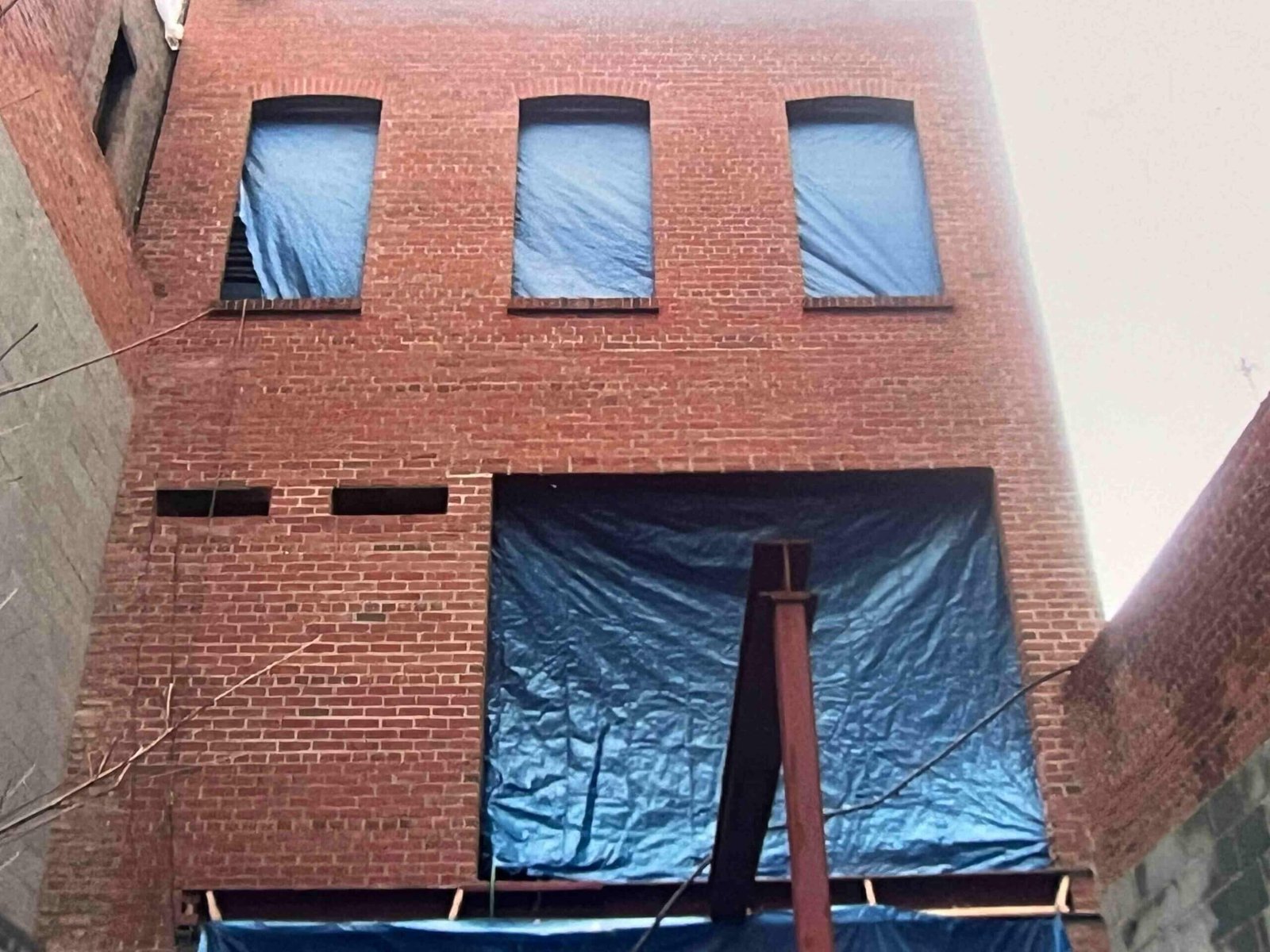
How does dustless brick pointing protect Manhattan properties?
Dustless brick pointing seals the facade against water infiltration while containing all demolition debris within a closed containment system, eliminating the silica dust exposure that standard grinding creates. This matters enormously in Manhattan’s dense streetscapes, where neighboring properties, open storefronts, and pedestrians are within feet of an active restoration site.
Our process begins with a diagnostic inspection: we map every joint that has failed, every section of brick that has cracked or spalled, and every area where water has tracked into the substrate. We then rake existing mortar to the required depth-typically 3/4 to 1 inch-using angle grinders fitted with HEPA-filtered shroud systems that capture particulate at the source.
Mortar matching is the most technically demanding part of the job. For Manhattan brownstones and pre-war brick buildings, we analyze the existing mortar’s sand color, aggregate size, and approximate lime-to-sand ratio. We source pigments and natural hydraulic lime to produce a custom mix that matches the original in compressive strength, breathability, color, and texture. This is non-negotiable for LPC-regulated properties and critical for the long-term health of any historic masonry wall.
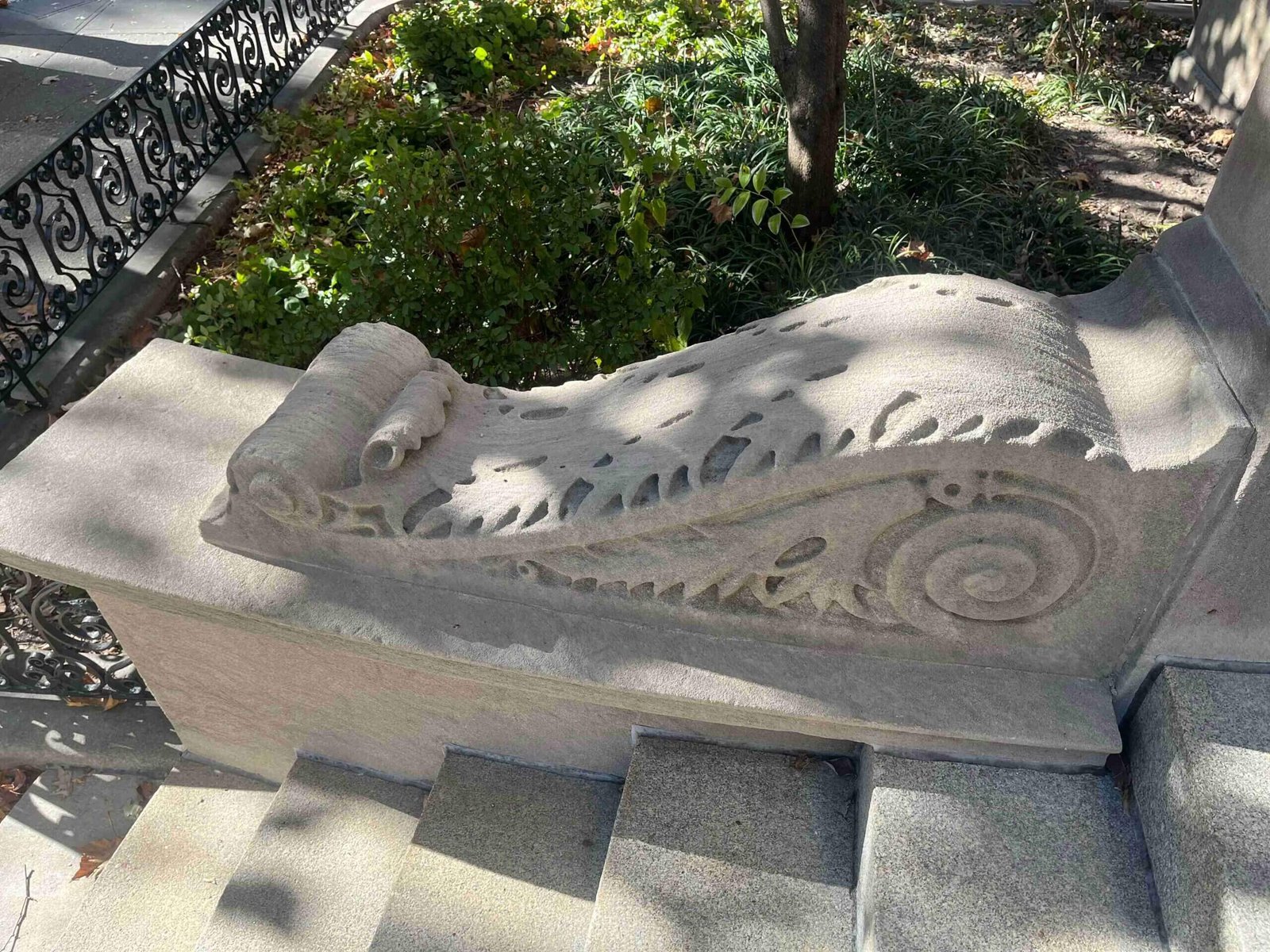
When a facade project uncovers degraded architectural stone-ornate lintels, carved keystones, or damaged window sills-our specialized division provides seamless stone restoration Manhattan solutions, maintaining the visual and structural coherence of the entire exterior.
Is MC Construction DOB and LPC licensed to work in Manhattan historic districts?
Yes – MC Construction pulls all required NYC Department of Buildings permits and operates under strict Landmarks Preservation Commission guidelines on every Manhattan project. Manhattan’s regulatory environment is unlike any other borough: zoning laws are denser, historic district boundaries are broader, and sidewalk protection requirements are stricter. We have built our entire operational model around full compliance from day one of every engagement.
Whether you own a single-family brownstone in the Greenwich Village Historic District, manage a multi-family pre-war building on the Upper West Side, or oversee a commercial property in Tribeca, our team handles the permit applications, LPC filings, and DOB inspections as a standard part of the project—not an add-on or afterthought.
FAQ
Do I need a permit for brick pointing in Manhattan?
Yes, in most cases – and the permit requirements in Manhattan are more complex than in other NYC boroughs. Any exterior masonry repair that involves scaffolding or a sidewalk shed requires a NYC Department of Buildings (DOB) permit for the temporary structure, regardless of the underlying repair scope. If your building is in one of Manhattan’s 142 designated historic districts or is an individual NYC landmark, you also need an LPC Certificate of No Effect (CNE) or Permit to Perform Work (PPW) before any visible masonry repair can begin.
The LPC review examines your proposed mortar mix, brick replacement specification, and joint profile to confirm they are compatible with the historic character of the building. This process typically takes 10–30 business days. MC Construction manages the entire permit process on your behalf as a standard part of every Manhattan engagement.
How much does brick pointing cost in Manhattan?
Brick pointing in Manhattan typically ranges from $12 to $35 per linear foot of joint, depending on access method, mortar specification, and the proportion of joints that require raking versus simple tooling. For a full facade restoration on a four-story brownstone, total project costs generally fall between $15,000 and $60,000 including scaffolding, permits, and LPC filing fees.
The main cost drivers are scaffold complexity, the extent of brick replacement required, and whether the project is in an LPC historic district. We provide detailed line-item estimates after an on-site diagnostic inspection, so you understand exactly what you’re paying for and why.
What is the difference between brick pointing and tuckpointing?
Brick pointing (repointing) is the process of removing deteriorated mortar from joints and replacing it with new mortar; tuckpointing is a decorative technique where a narrow ribbon of contrasting-color mortar is inlaid to create the illusion of fine joints. In Manhattan, most historic brownstones and pre-war buildings require repointing—the goal is structural repair and waterproofing, not decorative effect.
If a contractor offers to “tuckpoint” your deteriorating joints without first raking the old mortar to proper depth, they are likely describing cosmetic surface patching rather than genuine structural repair—a distinction that matters enormously for long-term building performance.
How long does masonry restoration take for a Manhattan brownstone?
A full facade restoration on a typical four- to five-story Manhattan brownstone takes 3 to 6 weeks of active work, not counting the permit lead time. The permit and LPC filing process typically adds 3 to 8 weeks before physical work can begin, so property owners should plan for a total project timeline of 6 to 14 weeks from contract signing to scaffold removal.
Factors that extend the schedule include elevated proportions of brick replacement, multi-elevation projects, and projects that uncover secondary issues such as failed lintels, deteriorated shelf angles, or damaged flashing. We build contingency scope into every estimate so secondary discoveries don’t create surprise cost overruns.
Can masonry and brick pointing work be done during winter in New York?
Yes, masonry work can be performed in winter in New York City, but it requires cold-weather protection measures to ensure the mortar cures correctly. Mortar must be protected from freezing for a minimum of 72 hours after application, which means heated enclosures, insulated blankets, and temperature monitoring become part of the site setup from November through March.
For property owners with water-active infiltration issues, we recommend not delaying repairs until spring—ongoing water infiltration through open joints does more cumulative damage during a single winter than the added cost of cold-weather protection measures.
How do I know if my Manhattan building needs structural masonry repair?
The most reliable indicators are visible mortar joint recession below 3/8 inch, efflorescence (white mineral deposits) on the brick face, staining or moisture on interior walls adjacent to the exterior, and cracking that follows the mortar joint pattern rather than cutting through the brick. These signs indicate the mortar-brick bond has been compromised and water is or soon will be infiltrating the wall assembly.
More serious structural indicators include bulging or bowing of a wall section, cracks that are wider at one end than the other, and bricks that sound hollow when tapped. In Manhattan, buildings that have not had a facade inspection in more than five years are required by Local Law 11 (FISP) to undergo a qualified inspection on a five-year cycle.
Does MC Construction handle Local Law 11 (FISP) masonry repairs in Manhattan?
Yes – MC Construction is an experienced FISP repair contractor, providing scope-compliant masonry restoration that satisfies the NYC DOB’s FISP Cycle 9 requirements for all Manhattan building classes. Under Local Law 11, buildings taller than six stories must have their facades inspected every five years by a Qualified Exterior Wall Inspector (QEWI).
We work directly with the QEWI of record to understand the required repair scope, execute the work in compliance with the inspection report, and provide documentation that supports the inspector’s final filing with the DOB. Our detailed field reports and photographic documentation are specifically formatted to support FISP compliance reporting.
Severe mortar erosion affecting over 60% of the facade joint depth, active water infiltration into the rear party wall, crumbling brick faces on the top two floors, and a failed lintel above the main entrance—all in an LPC-designated historic district requiring Commission approval before work could begin.
We submitted an LPC Certificate of No Effect application supported by a mortar analysis report and material specification sheet confirming our custom mix matched the original 19th-century composition. Simultaneously, we filed for a DOB-approved pipe scaffold with sidewalk shed covering the full building width.
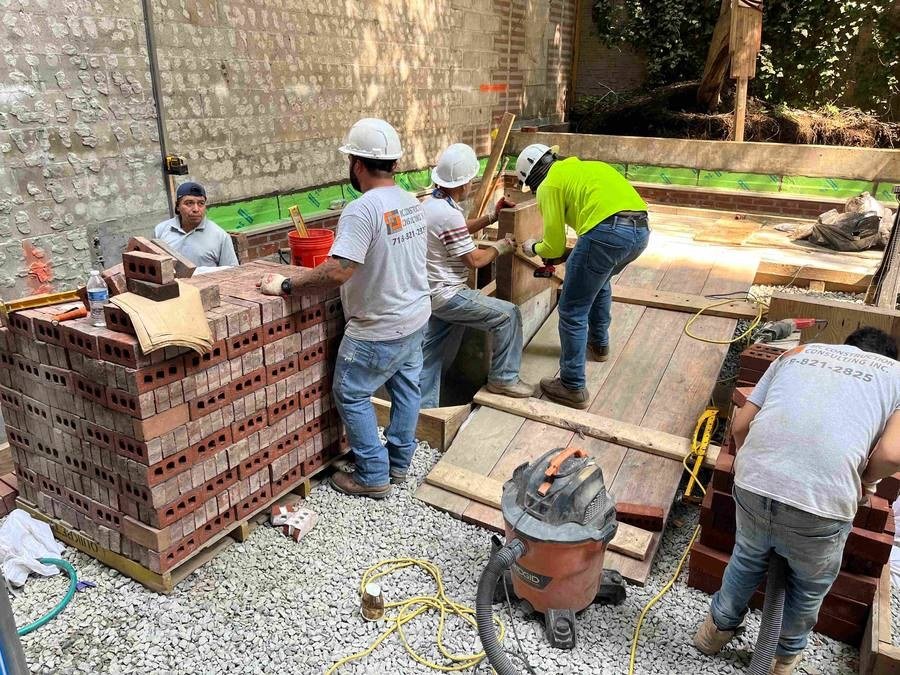
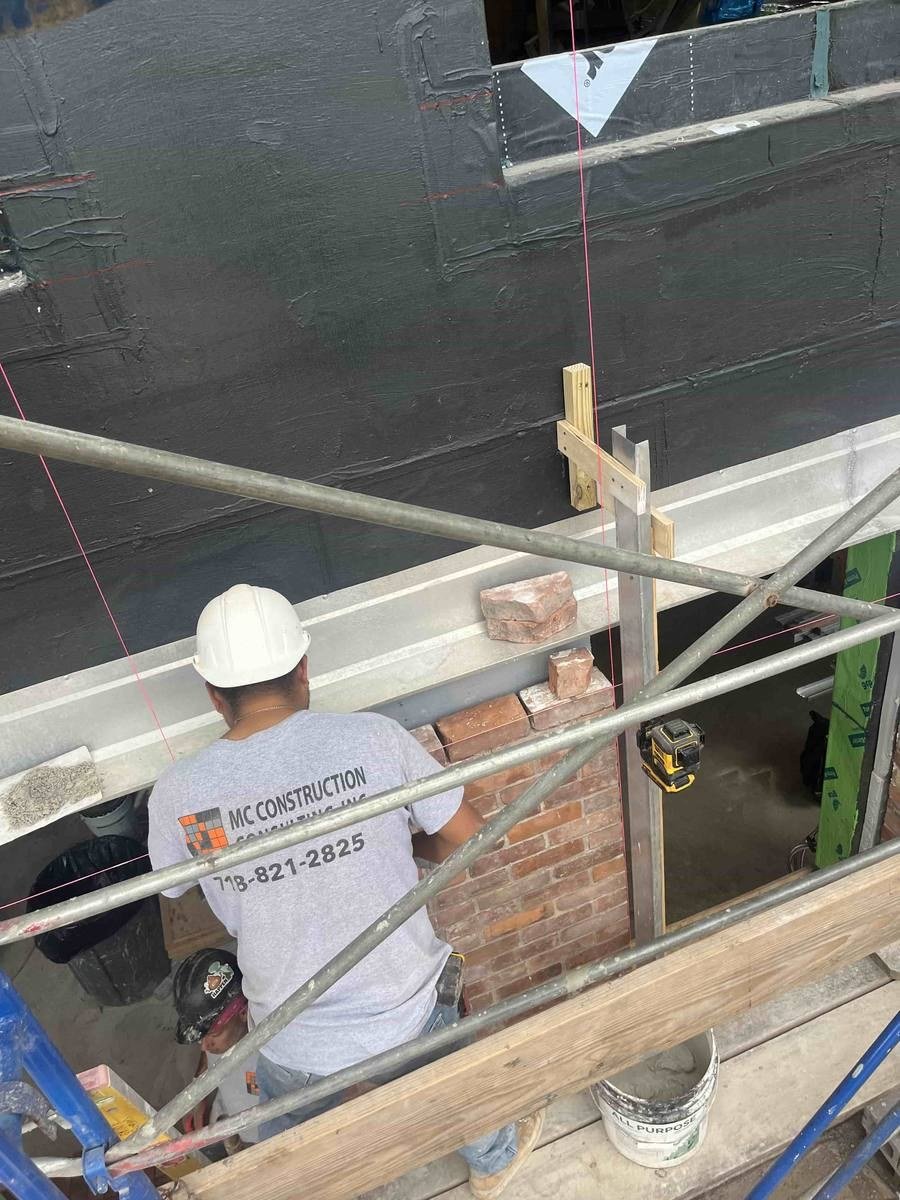
Crews raked all failing joints to 3/4-inch minimum depth using dustless angle grinders. Structurally compromised bricks on the upper floors were removed and replaced with period-matched salvaged bricks. The failed lintel was replaced with a new steel angle concealed by custom-cut matching brick. Custom lime-based mortar was batch-mixed on-site and applied in two stages to ensure proper cure and color consistency.
A fully watertight building envelope confirmed by post-installation water testing. Restored structural stability across all repaired sections. LPC final inspection passed without conditions. The building’s historic curb appeal is fully preserved, with mortar joints that are visually indistinguishable from the original construction.

We manage all necessary permit applications with the New York City Department of Buildings and prepare LPC approval packages for any project within a designated historic district. No shortcuts, no workarounds.

Our business carries high-limits general liability and worker’s compensation insurance explicitly rated for complex scaffolding installations and multi-story exterior operations in Manhattan—protecting you, your tenants, and the public.

Every street-level Manhattan project receives a DOB-approved sidewalk shed, containment netting, and pedestrian channeling. We coordinate directly with the NYC Department of Transportation for roadway use permits when required.

We work alongside licensed architects and structural engineers as a preferred masonry subcontractor. Our field documentation—mortar analysis reports, photo logs, and joint mapping—integrates directly with your design professional’s deliverables.
What does a full masonry restoration project look like in practice?
A complete restoration project moves through four phases: diagnostic survey, scaffolding and containment installation, masonry repair execution, and final inspection with documentation. The West Village townhouse project below illustrates how each phase connects and how the result delivers lasting structural performance alongside restored historic aesthetics.
West Village Townhouse Facade Restoration

Let’s Build Your Next Project Together
Reach out to our experienced team for expert restoration and construction services across New York City’s boroughs.